[continued from Teithoron Tegilbor's Tale (Part the First)]
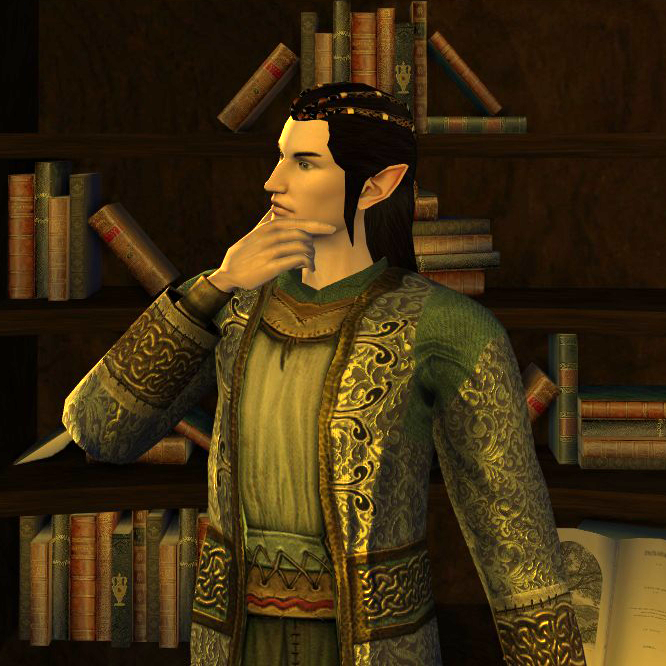
Teithoron Tegilbor studied his young pupil. Though he had known the boy for wellnigh a full turning of the seasons, he marked how small the child yet seemed to his eyes, dwarfed by the vast hearth in his chamber. Too long had it been since he had seen elf-children at play or heard their gay laughter and joyful singing, for few little ones were there among the Tawarwaith of Taur-nu-Fuin in these latter days, and Legelion was no doubt the youngest among them and the only one who oft frequented the Halls of Elvenking.
'Taur-nu-Fuin,' he thought gloomily, 'aforetime the name of the broad forest in Dorthonion, corrupted by Morgoth and turned to darkness; and now the name of our woodland home, corrupted by Sauron Gorthaur, fell servant of the First Enemy. But its other name is no less drear, Taur e-Ndaedelos... and thus does darkness and fear hang ever over the young life of this elf-child who sits here beside me; and yet so strong and gay a spirit is in him that his clan saw fit to name him Feveren, but no other life has he ever known. How glad his heart would have been to behold the enchanted greenwoods of old in Doriath; how great his delight to sing beneath the whispering beech-trees of Neldoreth or the great oaks of Nivrim!'
He well knew whence these bitter thoughts arose, for Legelion wished to know of the scribe's home of old in ancient Beleriand, where the Iathrim were once held to be the highest and noblest of the Grey-elven kindred. Memories long buried had risen in his mind, memories that he had no desire to stir. 'But here the child sits in pure innocence,' he thought, 'trusting me to answer the questions of his ever enquiring mind.' Then Legelion looked up into his eyes, and within that glance Teithoron beheld that deep trust that he had slowly earned over the past year of their unlikely friendship. And there, too, was a glimmer of the same love that had grown steadily within the old Grey-elf for the Green-elf boy.
And though in his heart he felt a stirring of profound joy, Teithoron said calmly, 'You asked why I speak little of my life in Menegroth, child. Understand that I did not always serve Lord Oropher -- and he was but a lord aforetime in Eglador, not yet a king -- and I dwelt not in Menegroth until Lest Melian was raised about the marches of Doriath. Indeed the Forest of Region was the abode of my kin, and we wandered heedless therein for many years amidst its holly-trees, but we dwelt chiefly in Dor Dínen betwixt the flowing waters of Esgalduin and Aros.
'But I was much like you in my youth, no hunter or warrior, but eager moreover for matters of thought rather than with making or with skill of hand, and I heard tell that in Menegroth dwelt Dairon, the loremaster and minstrel of King Thingol. For he it was that made the Certhas Daeron and the Angerthas Daeron thereafter, and I much desired to learn his art.'
'Nay, Teithoron!' the elf-child laughed. 'Here I must gainsay you, for my hands are indeed skilled and I now have strength enough to bend Cúlalf, my bow of elm-wood made for me by Echeleb Túbeng my father's father. A mighty hunter I would be, if not for our Laegren oath to never slay our woodland friends nor eat of their flesh!'
The scribe glanced at Legelion's wiry arms and smiled. 'Indeed,' he said, 'your slender limbs belie great strength, but is of your heart and mood that I speak. For your wit is sharper than any arrow you may draw with Cúlalf's bowstring, and your kind heart is more steadfast than anything your deft hands would craft!'
Again the boy's clear laughter sounded. 'It is but a single coranor that you have known me,' he said to his teacher, 'but it seems to me that you know me better than I know myself!'
'I am old,' the Grey-elf said, 'and with great age comes great wisdom, it is said!'
'You are wise indeed,' said his young charge, 'to befriend one such as I!'
Their merry laughter pealed round the cavern-chamber.
Legelion wiped tears of mirth from his eyes, and said, 'Let us return now to your tale of years.' For his curiosity was now aroused and his teacher was in a talkative mood.
'Certainly,' the elder Elf agreed, gratified by the boy's interest. 'But it is not a happy tale. For my tutelage under Dairon during the Long Peace ended on a sudden when he left Doriath and set out to search for Lúthien Tinúviel, daughter of Thingol.'
'Wherefore?' asked Legelion.
'Love,' the scribe replied sadly. 'Unrequited love. For Dairon loved fair Lúthien, but she did not love him. Thus did he betray her love for Beren to her father, and once more when Beren was held captive in Tol-in-Gaurhoth and she sought his aid. Hearken closely:'
"'Wherefore,' said he, 'should Daeron go
into direst peril earth doth know
for the sake of mortal who did steal
his laughter and joy? No love I feel
for Beren son of Barahir,
nor weep for him in dungeons drear,
who in this wood have chains enow,
heavy and dark. But thee, I vow,
I will defend from perils fell
and deadly wandering into hell.'"[1]
'Alas! So jealous love makes even the wise unkind,' the boy said.
'But you have not yet heard the Lay of Leithian in its entirety, and thus pass judgement in haste! For though his first betrayal of Lúthien's trust was indeed rooted in jealousy, the latter was made in love and fear for her wellbeing and he repented of his first deed.'
'It seems to me that love is perilous,' replied Legelion thoughtfully. 'Perhaps I should harden my heart to its embrace?'
'You are young,' said Teithoron, 'too young, perhaps, to understand the calling of the elven-heart. Love and marriage are the natural course of life for us.[2] And we are born to love, both the Earth and those who walk upon its face.'
'Yrch also?’ asked the boy dubiously, falling into the woodland tongue.
'Hah! Though we love not the servants of the Dark, we should accord them pity. Alhough perhaps this too is love, to some degree.' The scribe held up his long hand, for the elf-child's face was beset with doubt. 'But would you hear my tale, or instead debate matters of the heart?' he asked.
'I would hear your tale,' Legeion smiled.
'Then draw for us another cup of fine wine, and we shall journey forth!'
The boy did as he was bid, but ere his mentor continued he asked:
'But what became of Dairon the Minstrel?'
'It is said that seeking for Lúthien in despair he wandered upon strange paths, and passing over Ered Lindon he came into the East of Middle-earth, where for many ages he made lament beside dark waters for the daughter of Thingol, most beautiful of all living things.'[3]
'This tale brings to my heart much sadness,' said Legelion, 'but mayhap I should first hear the lay in its fullness?'
'Mayhap,' replied Teithoron drily, thinking of the lesson thereof he had prepared, but which was now abandoned. 'But let me first sate your curiosity for my own tale, and thus perhaps your wayward mind will be undistracted when we return at last to that esteemed poem!'
'Indeed!' the boy laughed.
'Well you know how the Years of the Trees came to their dire end, and therefore the long years of the War of the Jewels began. After the First Battle Elu Thingol withdrew his people into Neldoreth and Region, and Lest Melian was set about his realm. At this time many of your Laegren kin departed the greenwoods of Ossiriand to dwell within the guarded forests of Doriath, and not a few Grey-elves removed then to the fastness of Menegroth, I among them.
'There in its high halls I first laid eyes upon my beloved Raeneth, a maiden of Melian the Maia; slender she was and dark of hair, and her skin was white and pale, and she sang as she wove in many hues the visions of the Queen of Doriath. Entranced I straitway pledged my troth, and one year thereafter we were wed in joy beneath bright Anor, for She had but lately risen in the West to our great delight.'[4]
'You saw the first rising of the Moon and Sun?' gasped the boy in awe.
'I did,' replied his teacher, 'but of that we shall not now speak, for your thoughts have wandered to and fro enough for one day, child!'
Legelion hid his disappointment by studying his toes as he wriggled them before the fire's warmth.
'For nigh four hundred years and sixty I studied with Dairon, learning all I could of the Angerthas; and when he was lost, Lord Oropher took me as a scribe into his House, for fair Raeneth was a kinswoman to him. But in that time the Golodhrim were ever at war with the Dark Power of the North: victory first in the Dagor Aglareb and the Siege of Angband was raised thereafter; but then defeat in the Dagor Bragollach and the Siege broken asunder. But Elu Thingol had little love for the Exiles, and less even when he learned the truth of the Kinslaying at Alqualondë. Great was his wrath, and he spoke thusly:
"But hear my words! Never again in my ears shall be heard the tongue of those who slew my kin in Alqualondë! Nor in all my realm shall it be openly spoken, while my power endures. All the Sindar shall hear my command that they shall neither speak with the tongue of the Noldor nor answer to it. And all such as use it shall be held slayers of kin and betrayers of kin unrepentant.’ [5]
'And thenceforth Quenya was no longer spoken? A whole tongue forbidden!' exclaimed the young Green-elf.
'Such is the mood of mighty kings,' sighed the scribe. 'The High Speech of the West was thereafter spoken only by the lords of the Gelydh among themselves.'
'Can you yet speak it?'
'I can read it, for it lived on as a language of lore, but in the long count of years I have forgotten much.'
'Now of the Nauglamír and the slaying of the High King you have heard from your father's father, you said. And you know also of the Battle of the Thousand Caves which Raeneth and I survived by chance, for the House of Oropher was not at Menegroth on that day of doom. For in grief for the death of Thingol our lord had led us to the Forest of Neldoreth as a hunting party, but in truth he wished to inspect the marchwardens there for Melian's enchantments had fallen when she departed Ennor, and they were guards from his House.
'Alas that we were not so fortunate on that grievous midwinter day when the Sons of Fëanor brought Doriath to ruin in their Second Kinslaying.' Teithoron fell silent, his downcast eyes shadowed.
Legelion's own eyes were wide, and he said, 'Speak no more of that fell misdeed, for now I know of your great hurt!'
The scribe nodded gratefully. 'The remnant of the Iathrim followed Elwing, daughter of Dior Eluchíl and Nimloth who both perished in the assault, and Lord Oropher and I were among them; and we fled thereafter to the havens at the Mouths of Sirion. Alas, Elwing brought with her the Silmaril that had brought about the downfall of our home, and so there came to pass the last and cruellest of the slayings of Elf by Elf;[6] for the Sons of Fëanor followed and sacked the Havens, and great was the slaughter of the folk thereof. But they gained not their prize, for Elwing took the Silmaril and cast herself into the cold dark waves of Belegaer.
'Know you the tale of Gil-Estel?' he asked the boy.
Legelion nodded. 'Gellin my father has told me of Gaerdil, but I should also like to hear that lore in your own words.'
'A tale for another day, then,' said his teacher. 'But my own is now almost ended...'
'Now tidings of the onslaught came to Círdan and Ereinion Gil-galad at their refuge on the Isle of Balar, and they hastened to the Havens of Sirion, but came too late. Those that endured the assault they carried on their ships back to the Isle, and there we dwelt until the War of Wrath when we fled to Lindon, the new kingdom founded by Gil-galad, who was crowned High King of the Elves of the West.'
'There my Laegren kin dwelt also, for a while. But they swiftly removed hither to join with the Tawarwaith, our Danwaith kin.'
'Swifter indeed than we Thindrim!' Teithoron smiled grimly. 'Few Teleri who refused the summons to Avon desired to be ruled by the Golodhrim, and seven hundred years and fifty thereafter the remnant of the House of Oropher entered Eryn Galen also.'
'And here you are,' said the boy in jest.
'And here I am,' the scribe agreed.
'But,' asked Legelion in earnest, 'Wherefore? Why not the wide lands of Eriador rather?'
'For we wished indeed to become Silvan folk and to return to the simple life natural to the Eledhrim ere the invitation of the Rodyn to Dor-Rodyn had disturbed it,'[7] Teithoron replied.
'You deem the onset of the Great Journey was a mistake?'
'It is not a common thought, but there are those who deem the Rodyn erred, and removing our kindred unto Avon was not in fact according to the design of Eru, but arose from their fear of Melkor; and, it might be said, from their failure in trust of the One.[8] But we shall speak no more of this 'til perhaps you are older and wiser!'
Legelion was aghast, his eyes and mouth open wide, and Teithoron reached our a slender finger to the boy's chin and gently pressed his jaw shut. The boy grinned, 'I shall say naught of it. But though you have closed my lips, you have indeed opened my mind!'
'Then my work is done,' smiled his teacher.
* * *
[1] The Lay of Leithian
[2] Morgoth's Ring, "Laws and Customs among the Eldar"
[3] The Silmarillion, "Quenta Silmarillion: Of Beren and Lúthien"
[4] "Varda [...] set them to voyage upon appointed courses above the girdle of the Earth from the West unto the East and to return."
- The Silmarillion, "Quenta Silmarillion: Of the Sun and Moon and the Hiding of Valinor"
[5] The Silmarillion, "Quenta Silmarillion: Of the Noldor in Beleriand"
[6] The Silmarillion, "Quenta Silmarillion: Of the Voyage of Eärendil and the War of Wrath"
[7] Unfinished Tales Part 2: "The Second Age" Appendix B: "The Sindarin Princes of the Silvan Elves"
[8] Parma Eldalamberon 17/178
 It should be noted that this tale is set in the 2978th year of the Third Age, when Legelion was but thirteen years of age; also that these anecdotes are not in strict chronological order.
 |
xii |  |